
How to Use Haidy: The Physician's Perspective
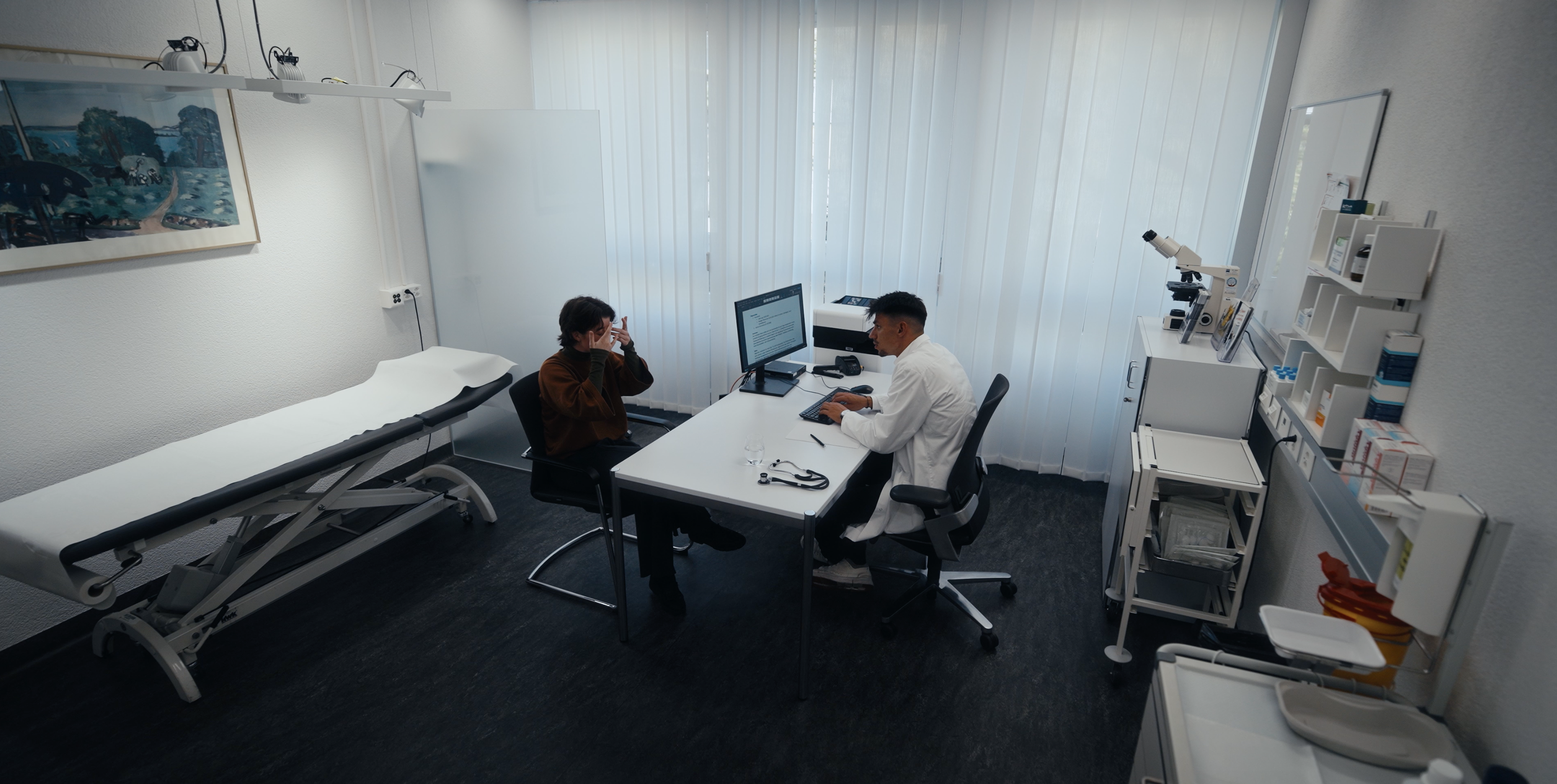
Medical documentation is one of the most time-intensive tasks in clinical practice. With Haidy, we are enabling a new approach: an AI scribe that can document a complete consultation.1 Haidy is an intelligent system that structures the content of conversations and documents and transfers it directly into the patient information system.
Thanks to integration with leading hospital information systems (including KISIM/Cistec, EPIC, INES KIS, WinMed, Axenita, and Aeskulap), Haidy can link existing information from the patient record with the current consultation and directly create new reports or progress notes. Future extensions will also cover appointment coordination and communication with other care providers.
More Than Speech-to-Text: Content Understanding as the Key
The decisive difference from conventional dictation solutions lies in the content-level understanding of conversations and documents (information in the broadest sense) and in the ability to structure this directly. Haidy doesn’t just transcribe spoken words — it interprets their medical meaning in context and structures the information accordingly.
Report quality measurably increases when as much clinically relevant information as possible is verbalized during the consultation.23
This can be specifically supported through the consistent application of established medical communication techniques (such as NURSE).4 By naming emotions or repeating symptoms, Haidy also captures non-verbal information and correctly categorizes the significance of a symptom.
Verbalizing examination findings directly during the examination enables their immediate capture. Important elements of the doctor-patient relationship, such as shared decision-making about further therapy or next steps, simultaneously help Haidy document these correctly.
Practical Tips for Use in Daily Practice
The following approaches are recommended for optimal use:
Combination of Conversation and Post-Processing:
Particularly efficient is the combination of a guided conversation with subsequent dictation of report elements that were not verbalized directly in front of the patient or only become available later (e.g., lab or radiology results as well as the final clinical assessment).
Processing Unstructured Documents:
Haidy also recognizes and processes scanned or unstructured documents, such as lab reports in PDF form, and correctly transfers them into structured documentation.
Communication Techniques as Documentation Aids:
Standardized communication structures such as NURSE also prove to be an effective method for optimizing Haidy’s documentation quality.

Limitations of the Technology: Critical Review Remains Essential
AI scribes show their strengths primarily with standard clinical presentations — i.e., symptom patterns that follow a typical disease course. With diffuse or atypical manifestations, however, difficulties can arise, particularly regarding the clear articulation of the system’s own knowledge boundaries.
A critical review of the generated report is therefore essential, especially in complex or unclear cases.
Additionally, it should be noted that medical assessment, diagnosis derivation, and clinical reasoning will remain the domain of humans for the foreseeable future.56
From Scribe to Decision Support Tool
Haidy’s reasoning capabilities — its so-called clinical reasoning — are developing rapidly. We expect that AI scribes will increasingly be linked with decision support functions in the future, providing evidence-based support for clinical decision-making processes.
For physicians, this primarily means substantial relief from documentation and administrative tasks.7
This allows physicians to refocus on clinical skills — which will not be replaceable by AI tools for the foreseeable future.

References
Footnotes
-
Sanmark, E. et al. Impact of an AI medical scribe after 375,000 notes generated across care levels in a European health system. medRxiv (2025). https://doi.org/10.64898/2025.12.06.25341757 ↩
-
Greenwood JD, Matthews MR, Overgaard JD, Ohde JW. Maximizing Efficiency of Artificial Intelligence-Enabled Ambient Scribes in Outpatient Settings: A Pragmatic Approach to Structuring the Patient Appointment. Mayo Clin Proc Digit Health. 2026;4(1):100339. doi:10.1016/j.mcpdig.2026.100339 ↩
-
Draper TC et al. Clinical AI Scribes in primary care: accuracy, error severity and implications for clinical practice. BMJ Digital Health & AI. 2025;1:e000092. https://doi.org/10.1136/bmjdhai-2025-000092 ↩
-
Patterson J, Kovacs M, Lees C. Ambient Artificial Intelligence Scribes: A Pilot Survey of Perspectives on the Utility and Documentation Burden in Palliative Medicine. Healthcare. 2025;13(17):2118. https://doi.org/10.3390/healthcare13172118 ↩
-
McCoy LG et al. Assessment of Large Language Models in Clinical Reasoning: A Novel Benchmarking Study. NEJM AI. 2025;2(10). DOI:10.1056/AIdbp2500120 ↩
-
Kim J et al. Limitations of large language models in clinical problem-solving arising from inflexible reasoning. Sci Rep. 2025;15:39426. https://doi.org/10.1038/s41598-025-22940-0 ↩
-
Tierney AA et al. Ambient Artificial Intelligence Scribes to Alleviate the Burden of Clinical Documentation. NEJM Catal Innov Care Deliv. 2024;5(3). DOI:10.1056/CAT.23.0404 ↩
Want to learn how Haidy can make a difference in your practice?
Get in touch now →